Kevin Singletary
Supply Chain Management (SCM) isn’t just about trucks, warehouses, or spreadsheets—it’s a strategic lens through which we can visualize how a business truly operates. Over the years, I’ve found that a well-mapped supply chain can tell the story of an organization more clearly than a hundred PowerPoint slides. Whether I’m talking to new hires or a room full of CEOs, I focus on simplifying complexity—breaking down sprawling operations into visual tools that highlight where our risks, inefficiencies, and opportunities lie.
Why does this matter? Because the supply chain is where risk lives: regulatory shifts, DOT compliance, environmental concerns, quality control, FSMA 204, financial audits—you name it. Without clear visibility, risk thrives. With clarity, we manage it.
Mapping the Supply Chain: The SCORE Model
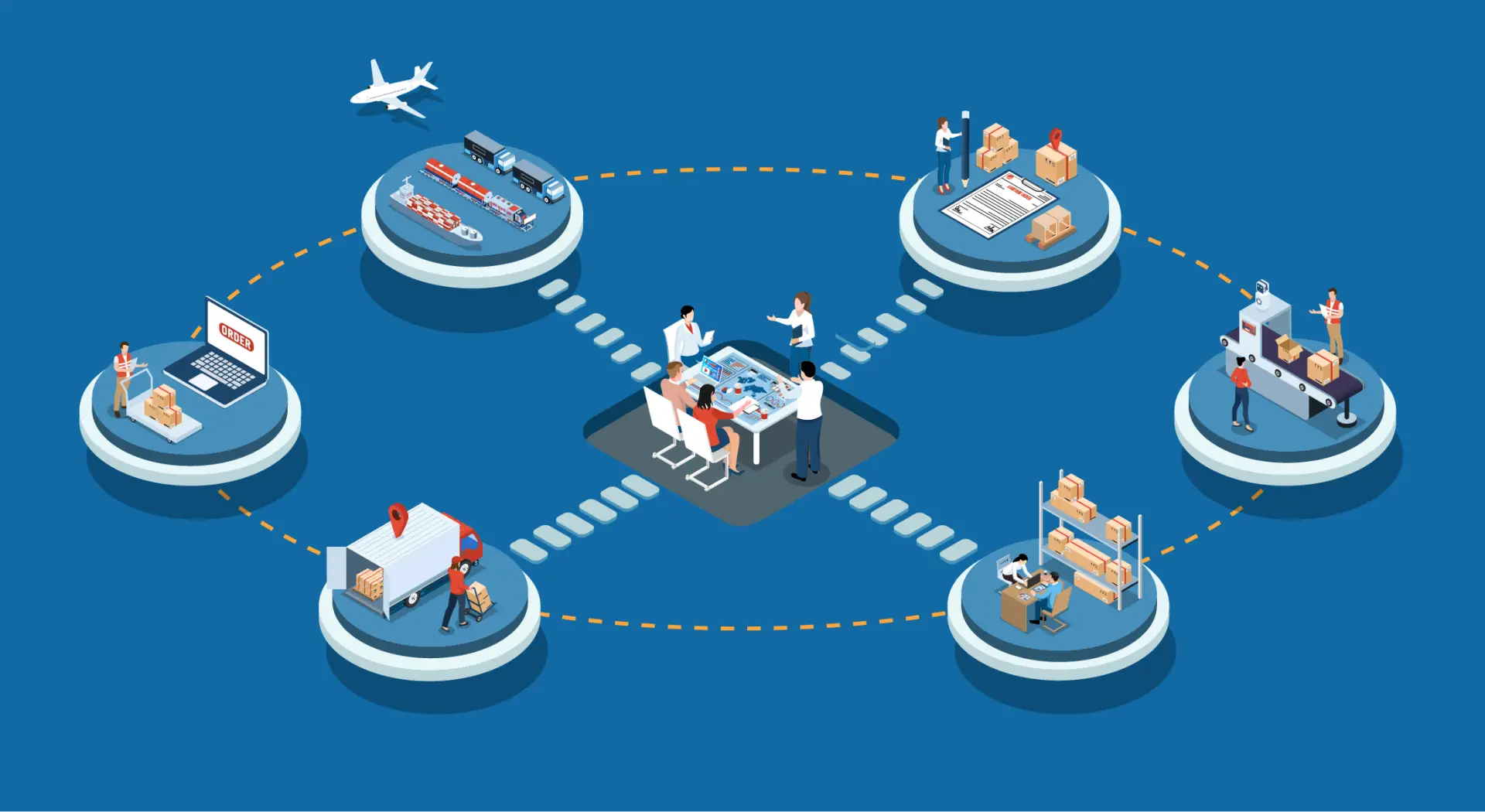
One of the most effective tools I use is the Supply Chain Operations Reference (SCORE) model. This model provides a comprehensive view of your supply chain, acting as a bird’s-eye map that shows everything from your suppliers on the left to your customers on the right. It also includes core processes like sourcing, making, and delivering, clearly understanding your entire supply chain.
When you put this on paper, things start to click. It empowers leadership and frontline teams to see not only how product flows—but how information, compliance, and cost flow, too. And if you’re doing Sales and Operations Planning (SNOP) right, your materials, labor, and strategy all move in sync with your demand.
Juice Plant Optimization: A Real-World Case
One example that sticks with me is from a juice plant I worked with. The team couldn’t meet demand and thought their equipment was the issue. However, after a simple value stream mapping session, we discovered the real problem: their filler machine was running at 700 bottles per minute when they only needed 100. This 100 bottles per minute—that’s their takt time. Once they understood that, the team was able to eliminate the waste and stress, turning around years of missed targets without the need for new machines.
Once they understood that, the team eliminated the waste and stress. They didn’t need new machines—they needed new awareness. That one insight turned around years of missed targets.
Takt Time vs. Cycle Time: Know the Difference
If you’re going to map your supply chain right, you need to understand two key metrics:
- Takt Time: This is how fast you need to produce to meet customer demand. It’s fixed. It’s non-negotiable.
- Cycle Time: This is how fast your process or machine can produce. This one can be optimized.
By aligning your cycle times to your takt time, you not only uncover inefficiencies and spot safety issues, but you also cut scrap and improve predictability and output. This strategy ensures that your production process is in sync with customer demand, leading to a more efficient and effective supply chain.
Driving Continuous Improvement with Cross-Functional Teams
Real transformation doesn’t happen in isolated silos—it happens when we bring cross-functional teams together. That’s why I push for Kaizen events. These aren’t just workshops; they’re action labs. We get everyone—from floor operators to executives—to solve real problems in real-time.
The goal? Move from “current state” to “future state” within four to six months. No long lead times, no theoretical solutions—just mapped improvements, aligned KPIs, and results that stick.
The Power of Proactive Partnerships
I’ve seen what happens when mapping and communication are done right. Take our work with Home Depot: a potential distribution bottleneck could’ve derailed peak season deliveries. But because we had already mapped the supply chain, we adjusted schedules and avoided chaos.
Same thing with Walmart. They blamed shipping damage on our side—until mapping revealed it was their internal stacking practices. Problem solved. Trust earned. That’s what happens when you build transparency into your partnerships.
Mapping Techniques That Work: Value Stream + Cause Mapping
Two tools I always recommend:
- Value Stream Mapping (VSM) gives you a wide-lens view of your processes.
- Cause Mapping zooms in on specific problems and pinpoints root causes.
Use them together, and you’ve got a toolkit that not only diagnoses but also prescribes. That’s how you lead with facts—not assumptions.
Another tool that can be helpful is Process mapping. It is a technique that visually outlines the steps, decision points, and involved parties in a business process or workflow. It can be used to understand a process inside the VSM that needs to be understood.
A specific example of dealing with “We’ve always done it that way here!”
“We used VSM to discover that a production preparation team was using residential piping to fill 20,000-gallon tanks for production. A standard process that had been in place for over 20 years was uncovered through VSM and teamwork. This wasteful process wasn’t apparent because the batching team came into work 4 hours early to fill the tanks. The VSM batching process box that captures key KPI’s like Capacity, Quality, and Cycle time revealed this was a huge bottleneck, a waste of time and labor cost. This was eliminated by installing a 6-inch commercial capacity valve. An easy, cost-effective solution that the team celebrated as a better work process for them.”
Building Resilience in the Face of Regulatory Shifts & Tariffs
One of the most pressing concerns today is how regulatory changes and tariffs are shaking up supply chains—especially in consumer products. We can’t afford to be reactive anymore. We need to design resilience into our supply chain strategy. Here’s how I recommend doing it:
Multi-Sourcing & Supplier Diversification
- Don’t get caught in a single-country dependency trap.
- Consider “China+1” or “China+2” sourcing strategies.
- Build relationships in Southeast Asia, Latin America, and Eastern Europe.
Tariff Engineering & Product Design Optimization
- Adjust product composition or final assembly points to reduce tariff classification.
- Break down or reconfigure SKUs to minimize duties.
Flexible Logistics & Distribution Models
- Leverage bonded warehouses or FTZs to defer duties.
- Build modular logistics systems that can shift distribution on a dime.
- Use multi-modal transport to avoid bottlenecks at vulnerable ports.
Implement Value Stream Mapping for FSMA 204 Compliance
With FSMA 204 taking center stage, companies need to step up their supply chain maturity. VSM is a powerful way to integrate compliance into operations—not as an afterthought, but as a built-in capability. By mapping for takt time and FSMA traceability, companies align with consumer expectations, regulatory mandates, and operational excellence all at once.
Collaboration Is the Secret Weapon
The companies that succeed at this don’t go it alone. They activate cross-functional collaboration—from sales and procurement to QA and compliance. This breaks down silos and gets the entire organization rowing in the same direction.
Data-Driven Decisions = Supply Chain Strength
Your gut’s important—but your data is king. VSM helps visualize waste, bottlenecks, and compliance gaps. But when you pair that with real-time data analysis, you move from guesswork to precision. That’s where continuous improvement turns into measurable growth.
Layer on Complementary Tools
Value stream mapping gets you far, but combine it with tools like cause mapping, FMEA, or scenario planning, and you’ve got a full strategic playbook. That’s how we stay ready—not just for FSMA 204, but for whatever comes next.
Final Thoughts
Look—supply chains aren’t just about moving stuff. They’re about moving information, managing risk, and creating shared understanding across every function of your organization.
As I often say: “We’re always chasing the numbers, but we’re always managing risk.” Regulatory changes, FSMA, DOT, environmental concerns, SOX compliance—they don’t stop. But neither do you when your supply chain is visible, resilient, and flexible.
Map it. Understand it. Improve it. That’s how you unlock potential—from the factory floor to the C-suite.
About The Author:
Kevin Singletary
Supply Chain Coach, FSO Institute
Former VP Warehouse OPEX, US Foods
Kevin is an innovative and results-driven senior global supply chain leader with a successful record of accomplishment in End-to-End supply chain excellence, manufacturing, strategic sourcing, sales & operations planning, and logistics. He has proven capabilities in vendor management, compliance, continuous improvement, and strategic planning. He is also proven in successful business acquisitions, integrations, and turnarounds.